Case study
SOCA — AI-Powered Task Management System
A full-stack task management web application that leverages generative AI to automatically break complex tasks into actionable subtasks, reducing cognitive overload and improving execution clarity.
Role
Full-Stack Developer
Environment
Independent Project
Duration
2024
Stack
PHP • MySQL • JavaScript • Bootstrap • Cohere API
Quick overview
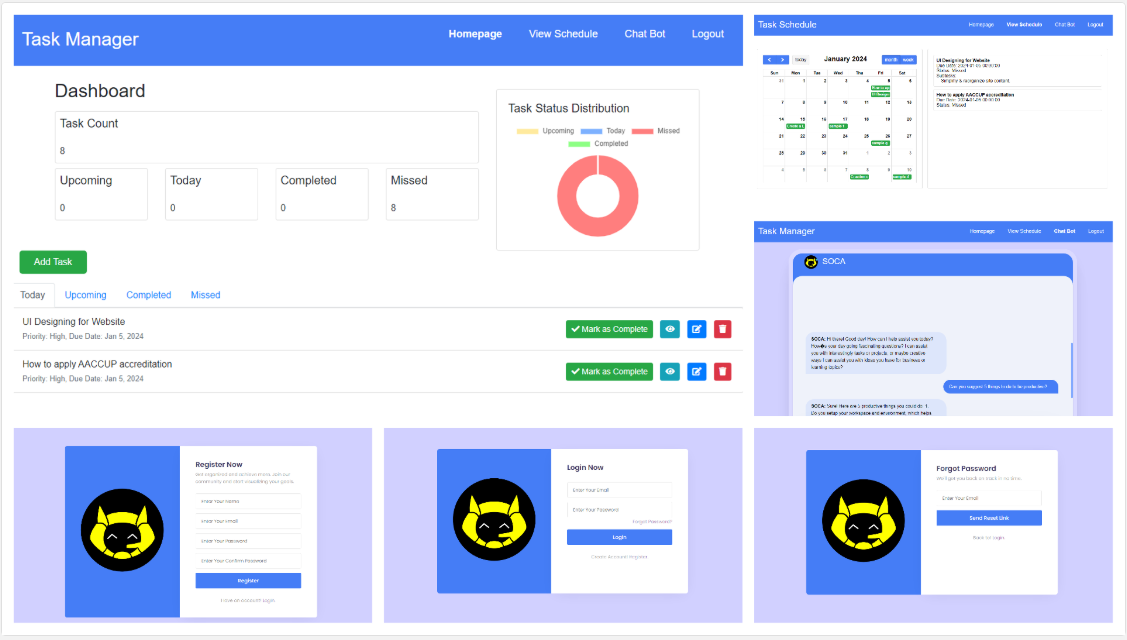
A web-based task management system that allows users to create, manage, and complete daily tasks, enhanced with AI-powered subtask generation.
Owned: End-to-end architecture, database design, authentication flow, AI integration, and frontend implementation.
The problem
Users often struggle to execute large or vague tasks because they lack structure and clarity. Traditional task managers rely entirely on manual task breakdown, which can increase friction and procrastination.
Constraints
- Limited infrastructure (PHP + MySQL stack)
- API usage limits and response latency from AI providers
- Need to maintain responsive UI while handling async AI calls
- Authentication and data isolation per user
Approach
I designed SOCA as a structured task manager first, then layered AI capabilities on top. The system stores core tasks in a relational database and, upon user request, calls the generative API to intelligently chunk large tasks into smaller actionable subtasks. I prioritized keeping AI generation optional and non-blocking to maintain usability even if external API calls fail.
System architecture
Frontend
HTML, Vanilla CSS, Bootstrap, JavaScript
CMS
N/A (Custom-built UI)
Data
MySQL relational database
Deployment
Traditional PHP hosting environment
Execution
- Designed relational database schema for users, tasks, and subtasks
- Implemented secure user authentication with Gmail login integration
- Built full CRUD functionality for tasks (create, edit, delete, mark as complete)
- Integrated Cohere API and LLaMA-based models for automated subtask generation
- Handled asynchronous AI responses and dynamically updated UI without full page reload
- Ensured user-level task isolation and secure data handling
Outcomes
- Reduced cognitive load by automatically converting large goals into manageable subtasks
- Improved task clarity and execution structure for end users
- Demonstrated integration of generative AI within a traditional PHP full-stack environment
- Built a functional AI-assisted productivity system from scratch
Reflection
If extending SOCA further, I would refactor the architecture into a more modern framework (e.g., Next.js + API layer), implement rate-limiting and caching for AI responses, and introduce smarter prioritization algorithms based on task metadata.