Case study
SmartRetry — Headless Fintech Marketing Platform
Architected and delivered a production-grade, multilingual fintech marketing platform built on Next.js 15 and deployed on Cloudflare Workers, integrating a headless WordPress CMS, automation workflows, and performance-focused infrastructure.
Role
Web Platform Engineer (Contract)
Environment
Remote Fintech Startup
Duration
2025
Stack
Next.js 15 (App Router) • TypeScript • Tailwind CSS • Headless WordPress • Cloudflare Workers
Quick overview
A modular, CMS-driven fintech marketing platform with multilingual support, dynamic content modules (directory, FAQ, glossary, blog), SEO optimization, automation workflows, and production-grade deployment.
Owned: Owned frontend architecture, CMS modeling, multilingual routing, automation integration, performance optimization, deployment workflow, and production reliability.
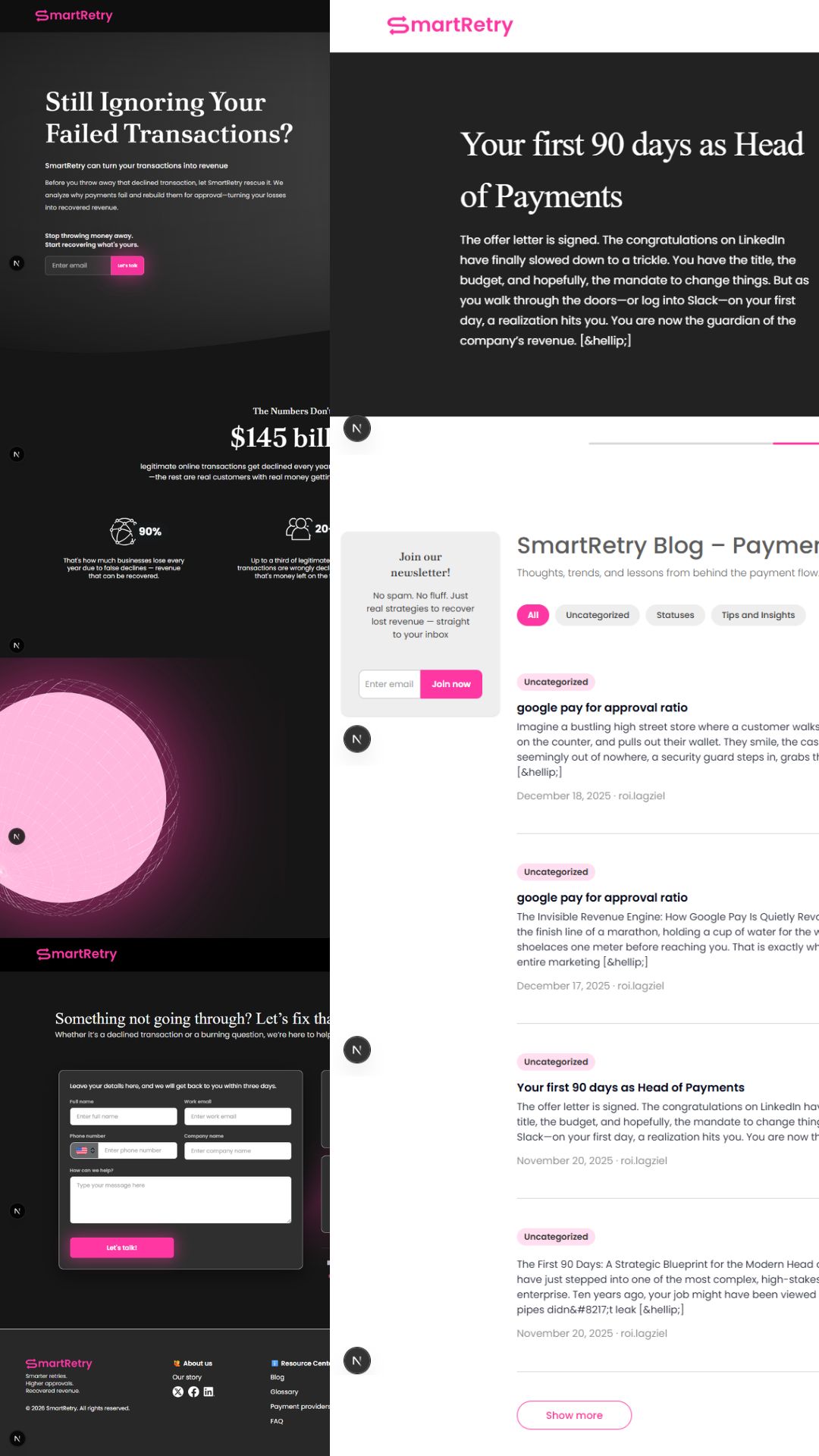
SmartRetry — Headless Fintech Marketing Platform
Remote Fintech Startup
The problem
The startup required a scalable marketing platform capable of rapid iteration, structured SEO content expansion, and multilingual support. The system needed to balance animation-heavy UX, dynamic CMS content, automation workflows, and production reliability — all within startup constraints.
Constraints
- Startup timelines with evolving requirements
- Headless WordPress behind a private Cloudflare Tunnel (no public CMS access)
- Need for multilingual and RTL support
- Animation-heavy UI without sacrificing performance
- Deployment on Cloudflare Workers (not traditional Node hosting)
- Strict security, monitoring, and SEO requirements
Approach
I designed the platform around a modular App Router architecture using Next.js 15 with server-side rendering for SEO and performance. WordPress was consumed headlessly via REST through a private Cloudflare Tunnel. Automation workflows were integrated using Make.com webhooks for CRM synchronization. I prioritized strict TypeScript boundaries, CMS structure clarity, and performance discipline to ensure scalability under evolving requirements.
System architecture
Frontend
Next.js 15 App Router + TypeScript + Tailwind CSS
CMS
Headless WordPress accessed securely via Cloudflare Tunnel
Data
—
Deployment
Cloudflare Workers with @opennextjs/cloudflare adapter
Execution
- Built multilingual routing system with dynamic locale-based pages and RTL support
- Implemented CMS-driven modules including directory, FAQ, glossary, blog, and structured content blocks
- Integrated Lottie animations with controlled client rendering to preserve performance
- Implemented React Hook Form + Zod validation for robust form handling
- Connected contact and newsletter forms to Make.com via webhooks for CRM automation
- Configured secure WordPress access through Cloudflare Tunnel (no public CMS endpoints)
- Deployed on Cloudflare Workers with optimized SSR and caching strategies
- Implemented structured SEO metadata, Open Graph tags, canonical URLs, and JSON-LD schemas
- Integrated Sentry for production monitoring and release tracking
Outcomes
- Delivered a scalable marketing platform capable of rapid content iteration
- Enabled secure headless CMS integration without exposing backend infrastructure
- Automated CRM workflows via Make.com, reducing manual data handling
- Maintained performance and SEO integrity despite animation-heavy UI
- Established a production-ready architecture suitable for future feature expansion
Reflection
This project reinforced that content modeling decisions directly shape frontend complexity in headless systems. It also highlighted the importance of balancing visual interactivity with performance discipline. Deploying on Cloudflare Workers required careful SSR considerations, strengthening my understanding of edge deployment constraints.