Case study
ResumeAI Tailor — ATS-Optimized Resume Generator
A free web application that helps job seekers dramatically increase their interview callback rate by generating ATS-optimized, tailored resumes in seconds using AI.
Role
Solo Full-Stack Developer
Environment
Web Application — Public
Duration
March 2026
Stack
Next.js • React • TypeScript • Tailwind CSS • Groq API (Llama 3)
Quick overview
A web application that accepts a user's resume and a job description, then uses AI to generate a tailored, ATS-optimized .docx resume for download.
Owned: Full-stack development, including frontend UI/UX, backend API development, AI integration, and prompt engineering.
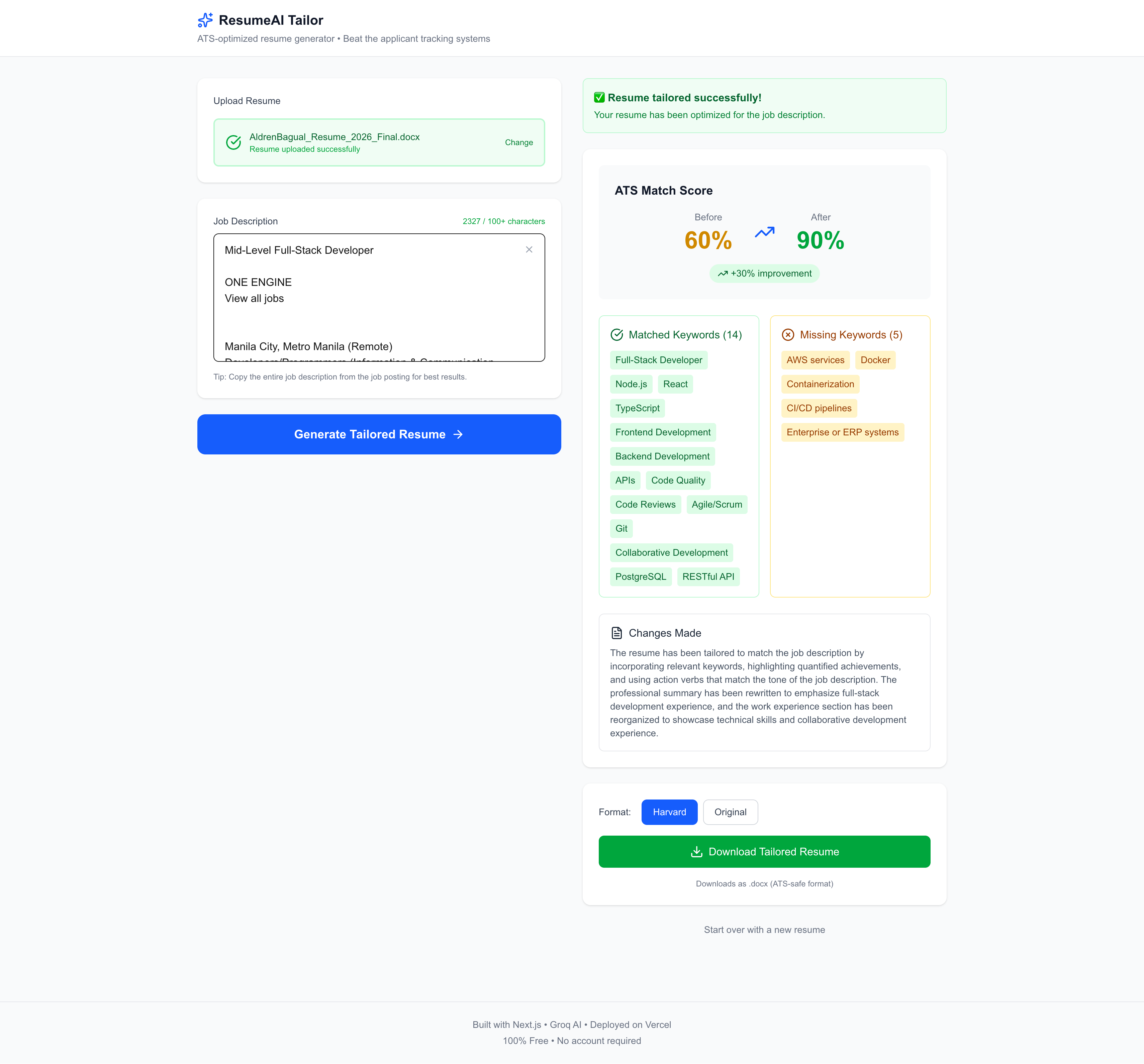
ResumeAI Tailor — ATS-Optimized Resume Generator
Web Application — Public
The problem
Most resumes are rejected by Applicant Tracking Systems (ATS) before a human reads them due to a lack of keyword optimization and proper formatting. Job seekers miss opportunities not because they are unqualified, but because their resumes fail automated screening.
Constraints
- Must use only free-tier APIs (Groq, Gemini) with no paid services.
- No database or user authentication in the MVP.
- Must be deployable on Vercel's free tier.
- Serverless function execution timeout of 10 seconds.
Approach
The project was built following a detailed Product Requirements Document and a step-by-step build guide. The architecture separates concerns into a reactive frontend, three distinct backend API routes for parsing, AI generation, and file export, and a robust AI integration layer with a primary/fallback mechanism to ensure high availability and performance.
System architecture
Frontend
Next.js (App Router), React, Tailwind CSS
CMS
N/A
Data
AI integration via Groq API (Llama 3) and Google Gemini API
Deployment
Vercel
Execution
- Developed a multi-step backend process: 1. Parse uploaded resume (PDF/DOCX). 2. Call AI with resume text and job description. 3. Generate a downloadable .docx file.
- Engineered a robust AI prompt to ensure consistent, high-quality JSON output for resume content.
- Built a modular component-based UI with React and Next.js for a clean user experience.
- Implemented a primary (Groq) and fallback (Gemini) AI service pattern to handle potential API failures.
- Ensured the generated .docx files were strictly ATS-compliant by avoiding columns, tables, and other problematic formatting.
Outcomes
- Dramatically reduces the time to tailor a resume from hours to seconds.
- Generates highly-optimized resumes designed to achieve a 70%+ ATS keyword match score.
- Produces professionally formatted, ATS-safe .docx files ready for immediate submission.
- Provides users with clear feedback on what was changed and why via a match score and keyword list.
Reflection
This project was a deep dive into full-stack development with a modern Jamstack architecture. It highlighted the power of LLMs in solving practical user problems and the importance of robust prompt engineering to get reliable, structured output from AI. Implementing the fallback API pattern was a key learning in building resilient systems.