Case study
Library Course-Based Computer Usage Monitoring System
Designed and built a desktop monitoring system that tracked computer usage by enrolled course, improving resource visibility and administrative efficiency within a university library environment.
Role
Lead Programmer (Intern)
Environment
University Library — Internal System
Duration
Sep 2023 — Jan 2024
Stack
Python • PySimpleGUI • Pandas • MS Excel • Desktop Application
Quick overview
A desktop-based monitoring system that tracked active computer users by academic course and generated structured usage reports for administrative analysis.
Owned: System design, UI implementation, data modeling, reporting logic, and on-site support.
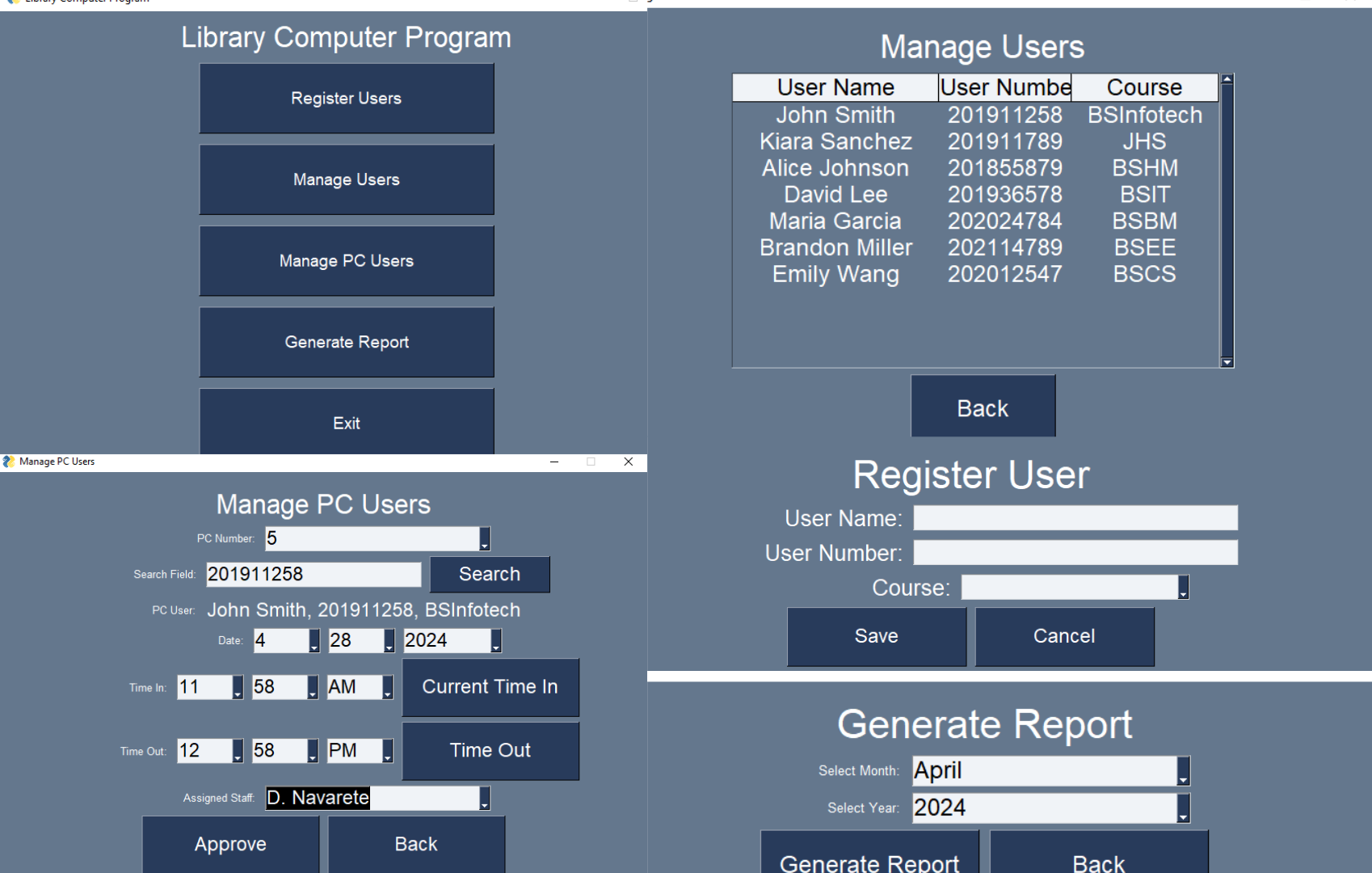
Library Course-Based Computer Usage Monitoring System
University Library — Internal System
The problem
The library lacked structured visibility into computer usage patterns across different academic courses. Monitoring was manual, time-consuming, and prone to record inaccuracies, limiting the administration’s ability to allocate resources effectively.
Constraints
- On-site infrastructure limitations (desktop-only environment)
- Non-technical staff as primary system users
- Need for reliable Excel-compatible reporting
- Minimal tolerance for system downtime during operating hours
Approach
I approached the project by first mapping the real-world workflow of library staff and identifying bottlenecks in data recording and reporting. The system was designed to simplify user registration tracking while automatically structuring data for export. Usability and clarity were prioritized over technical complexity to ensure seamless adoption by non-technical users.
System architecture
Frontend
PySimpleGUI desktop interface
CMS
N/A (Custom desktop system)
Data
Structured data handling via Pandas
Deployment
Local desktop deployment within library environment
Execution
- Designed user interface tailored for quick staff input and monitoring
- Implemented structured tracking of users categorized by academic course
- Built automated Excel export functionality using Pandas for reporting
- Optimized data handling to reduce manual encoding and errors
- Provided on-site software and hardware troubleshooting support
Outcomes
- Improved visibility into departmental computer usage trends
- Reduced manual reporting workload for library staff
- Increased record accuracy through structured data capture
- Delivered a practical internal system aligned with operational workflows
Reflection
This project reinforced the importance of aligning technical solutions with real-world operational processes. Designing for non-technical users required clarity and restraint — simplicity proved more valuable than adding advanced features.